Key facts in brief
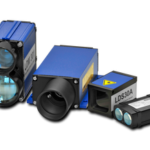
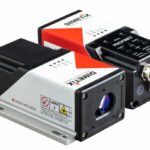
- Laser sensors give the highest accuracy and the smallest measuring spot, from micrometres at short range to hundreds of metres with phase shift.
- Ultrasonic sensors measure liquids, glass, transparent film and bulk solids regardless of colour.
- Dust, steam and foam favour ultrasonic. Fast, small or distant targets favour laser.
- In many plants both are used side by side: laser for positioning, ultrasonic for level and diameter.
Laser and ultrasonic distance sensors are the two technologies we are asked to compare most often. Both measure without contact and both are available with analog, IO-Link and switching outputs. But they behave very differently on real targets, and choosing the wrong one is the most common reason a measurement does not work on site.
How they differ in one sentence each
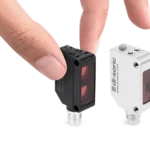
A laser distance sensor measures with a focused beam of light, using triangulation, time-of-flight or phase shift. An ultrasonic distance sensor sends a pulse of sound and measures the time until the echo returns.
Comparison at a glance
| Criterion | Laser | Ultrasonic |
|---|---|---|
| Accuracy | Very high, down to micrometres | Good, typically 0.1 to 1 mm resolution |
| Range | Millimetres to several hundred metres | A few centimetres to around 8 to 10 m |
| Spot or beam | Small spot, measures small parts | Wider sound cone |
| Transparent and liquid targets | Difficult | Very good |
| Dark or shiny surfaces | Depends on the model | Not affected by colour |
| Dust, steam, foam | Can be affected | More tolerant, foam absorbs sound |
| Response time | Very fast | Slower, limited by the speed of sound |
Choose a laser sensor when
- You need high precision, for example thickness, width or profile measurement.
- The target is small or far away and the beam must hit it exactly.
- The process is fast and you need short response times.
- You position cranes, trolleys or storage machines over long distances.
Choose an ultrasonic sensor when
- You measure liquids, granules or powders in a tank or silo.
- The target is transparent glass or film, or changes colour.
- The environment is dusty or humid and lenses would get dirty.
- You measure roll diameter or loop sag on web material in the paper industry.
Watch out for these traps
Laser sensors can struggle on mirror-like metal at steep angles and on hot, glowing steel unless they are designed for it. For hot steel applications choose a model with a suitable wavelength and protective housing. Ultrasonic sensors have a blind zone directly in front of the sensor and are affected by strong air movement and temperature gradients, so mount them where the air is calm or use temperature compensation.
What about cost?
Simple ultrasonic sensors usually cost less than precision laser sensors, but long-range phase-shift lasers and high-end triangulation sensors sit at the top of the range. Our distance sensor price guide for India shows typical price bands.
Still undecided? Describe your target and environment. Send us your application and our engineers in Pune will recommend a model and send a quote.
Read next: