Key facts in brief
- Check the IP rating: IP67 or higher for washdown, dust and outdoor installation.
- Hot targets such as glowing steel need sensors designed for them, often with cooling or protective housings.
- Dust and steam weaken optical signals. Air purge, longer wavelengths or ultrasonic sensors help.
- Outdoors, look for strong ambient light immunity and a heater for cold or condensing conditions.
Many of the distance sensors we supply in India end up in places that are anything but clean: hot rolling mills, cement and mining plants, paper machines full of steam and cranes that stand outdoors through the monsoon. In these conditions the datasheet range is only half the story. Here is what to check.
Protection class and housing
The IP rating tells you how well the sensor is sealed against dust and water. For most industrial and outdoor applications choose at least IP67. Metal housings resist knocks and heat better than plastic, and connector type matters too: an M12 connector with a good seal is easier to replace than a fixed cable.
Heat and hot targets
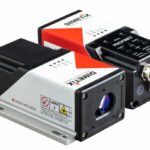
Two things get hot in steel and glass plants: the environment and the target itself. Check the ambient temperature range of the sensor, and add a cooling housing if the sensor sits near furnaces. Glowing steel emits strong light that blinds standard optical sensors. Sensors designed for hot targets, such as some ASTECH laser measuring devices, use filters and wavelengths that keep measuring on hot slabs and billets. Our page on the steel industry covers typical tasks.
Dust, steam and dirty lenses
Dust and steam scatter light and weaken the returning signal. Practical measures:
- Fit an air purge collar that keeps the lens clean.
- Choose a sensor with signal reserve and quality monitoring, ideally via IO-Link.
- Measure from a position where dust does not settle on the optics.
- For bulk material and level, consider an ultrasonic sensor, which tolerates dust better.
Outdoor use: sunlight, rain and cold
Direct sunlight can overload the receiver of an optical sensor. Long-range laser sensors for crane positioning are built with strong ambient light immunity, and a simple sun shield helps further. In cold or humid conditions, a built-in heater prevents condensation on the lens.
Vibration and mounting
Cranes, presses and conveyors vibrate. Use rigid brackets, secure the cable and, for long distances, align the beam carefully with a reflector or target plate. A small angle error at the sensor turns into a large offset tens of metres away.
Checklist for harsh conditions
- IP rating and housing material
- Ambient temperature range and cooling options
- Hot target capability
- Air purge or lens protection
- Ambient light immunity and heater for outdoor use
- Diagnostics to warn before the signal is lost
Working in a tough environment? Tell us the temperature, dust level and distance. Send us your application and our engineers in Pune will recommend a model and send a quote.
Read next: