Key facts in brief
- A distance sensor measures without contact. It has a transmitter, a receiver and electronics that turn the returning signal into a distance.
- Four principles cover almost every industrial sensor: triangulation, time-of-flight, phase shift and ultrasonic echo.
- Triangulation is the most precise over short ranges. Time-of-flight and phase shift reach tens or hundreds of metres.
- Ultrasonic sensors work on liquids, glass and bulk material regardless of colour.
A distance sensor tells you how far away an object is without touching it. Inside, every sensor has the same three parts: a transmitter that sends out light, a laser beam or sound, a receiver that picks up what comes back, and electronics that turn that return into a distance value. What differs between sensor types is how they measure the return.
1. Triangulation: highest resolution at short range
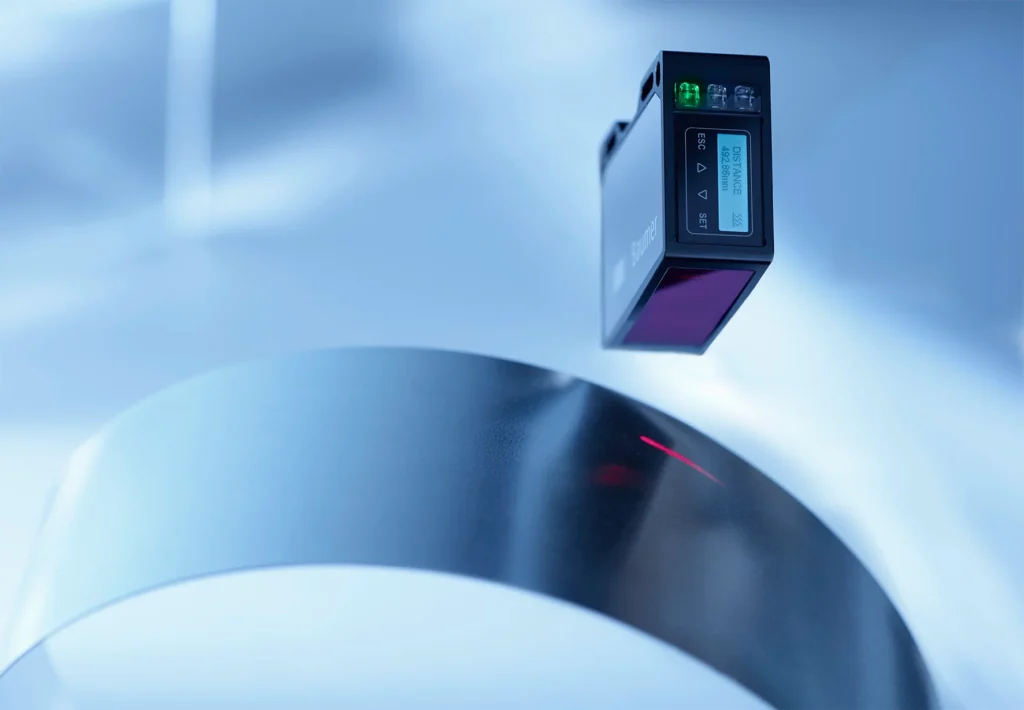
The sensor projects a light or laser spot onto the target. The reflected light falls onto a receiver at an angle. When the target moves closer or further away, the spot moves along the receiver, and the electronics calculate the distance from that position.
- Strength: resolution down to a few micrometres, fast response.
- Limit: short range, usually below one metre.
- Typical use: thickness, profile and run-out measurement with laser distance sensors.
2. Time-of-flight: long range, strong background suppression
The sensor sends a very short light pulse and measures how long it takes to come back. Light covers about 30 cm per nanosecond, so the electronics have to be very fast. In return you get long ranges and a sensor that ignores objects behind the target.
- Strength: ranges from a few metres to several hundred metres on reflectors.
- Limit: millimetre rather than micrometre resolution.
- Typical use: time-of-flight sensors for positioning, stacking and presence detection.
3. Phase shift: fine resolution over long distances
Instead of a single pulse, the sensor modulates its laser and compares the phase of the returning light with the light it sent. The phase difference gives the distance. This combines long range with fine, stable resolution.
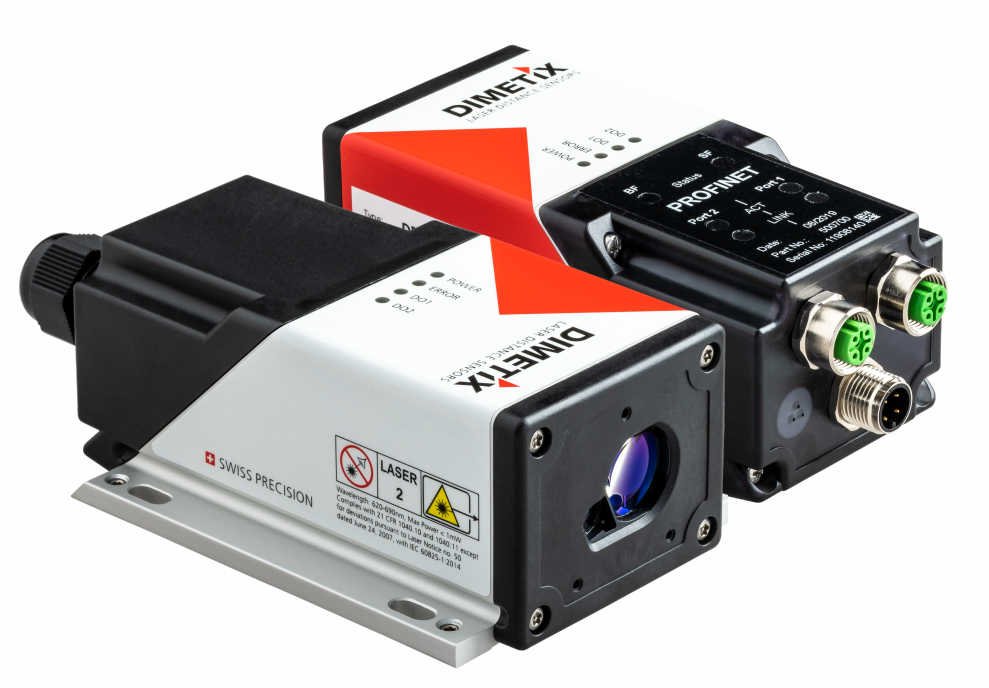
Phase-shift laser sensors are the standard for crane and trolley positioning and other long travel axes, and are used by manufacturers such as Dimetix.
4. Ultrasonic echo: works regardless of colour or transparency
An ultrasonic distance sensor sends a pulse of sound and times the echo. Because sound reflects from almost any surface, it measures liquids, glass, transparent film and bulk solids that confuse optical sensors.
- Strength: unaffected by colour, dust and steam to a large degree.
- Limit: wider beam and slower response than light.
- Typical use: level measurement in tanks and silos, sag control, roll diameter.
Scanning sensors: LiDAR
LiDAR sensors use time-of-flight but sweep the beam across an area. Instead of one value you get a line of points or a full point cloud, which is used for vehicle guidance, collision avoidance and area monitoring.
From signal to PLC
Finally, the sensor converts the distance into an output your controller understands: an analog 4 to 20 mA or 0 to 10 V signal, a digital IO-Link or RS485 value, or a switching output when a set distance is crossed. We explain the options in our guide to distance sensor outputs.
Which principle should I use?
Start with the target, the range, the accuracy you need and the environment. As a rule of thumb: triangulation for precision at short range, time-of-flight or phase shift for long range, ultrasonic for liquids and difficult surfaces. Our comparison of distance sensor types goes into more detail.
Not sure which principle fits your application? Tell us the target, range and environment. Send us your application and our engineers in Pune will recommend a model and send a quote.
Read next: