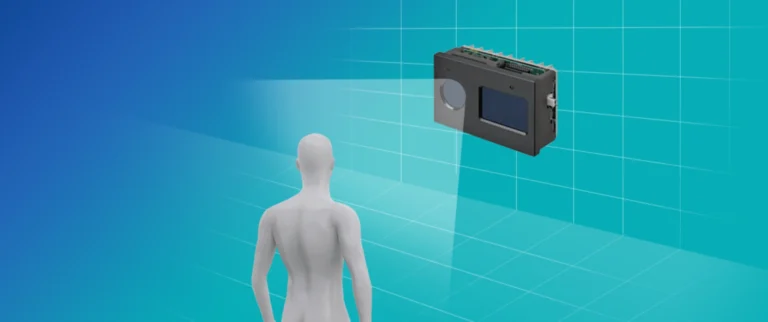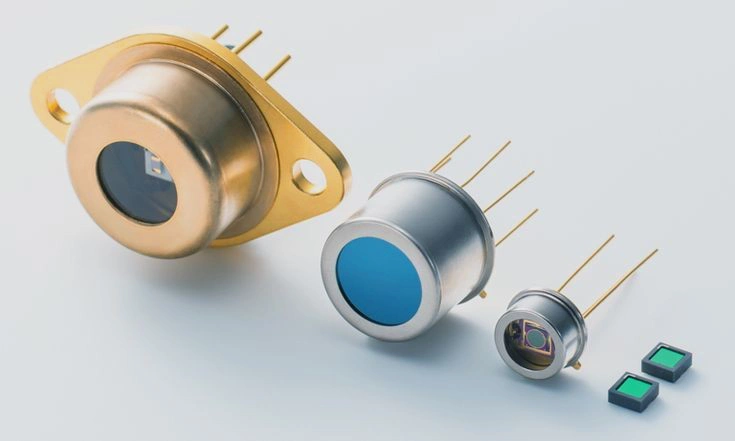
Infrared (IR) distance sensors use invisible light and a small optical receiver to estimate distance over short ranges. They are compact and low cost, which makes them popular in consumer devices, hobby projects and simple machines.
Most IR distance sensors work by triangulation: an infrared LED sends light, and the angle of the reflected spot on a position sensitive receiver tells the sensor how far away the object is. Other IR sensors use time-of-flight to reach a little further.
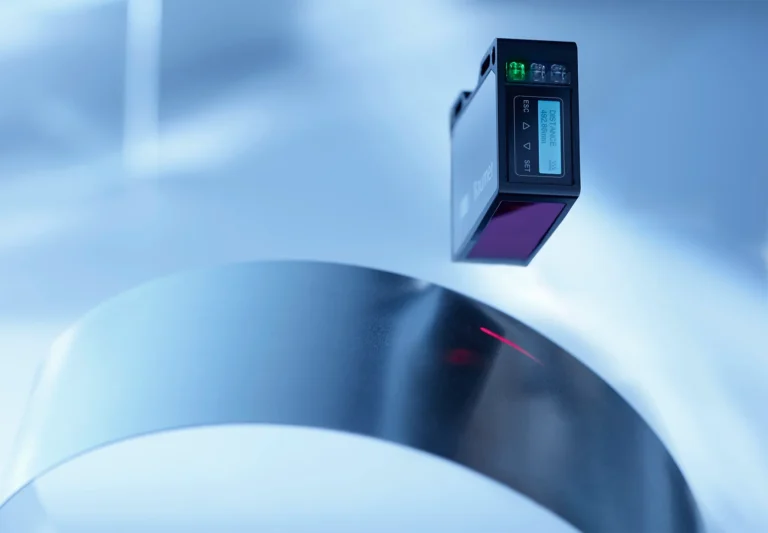
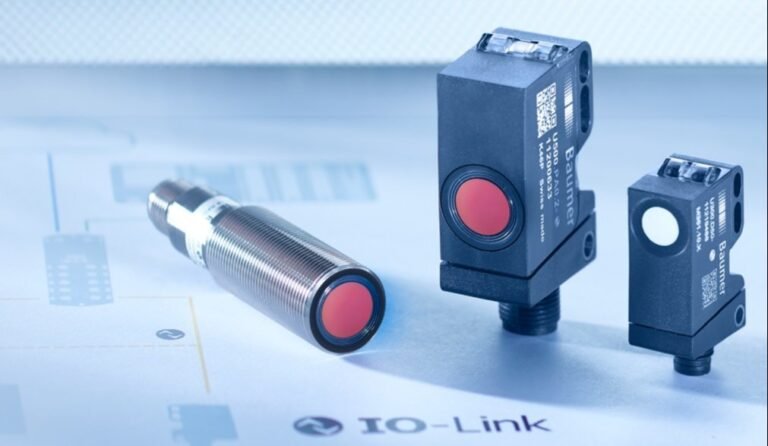
IR sensors are affected by sunlight, target colour and shine, and often give a non-linear output. For production lines where accuracy and repeatability matter, an industrial laser, time-of-flight or ultrasonic sensor is usually the better choice.
Measures the angle of reflected infrared light. Short range and compact.
Times an infrared pulse. A little more range and less colour dependence.
Laser and ToF sensors give linear, repeatable results with standard PLC outputs.
Values are typical for the technology. Exact figures depend on the model, so ask us for the datasheet that fits your application.
| Parameter | Typical value |
|---|---|
| Measuring range | Typically a few centimetres up to about 1.5 m |
| Accuracy | Varies with target colour and ambient light |
| Output | Often a non-linear analog voltage or a digital signal |
| Light source | Infrared LED |
| Typical uses | Robots, appliances, presence detection, education |
| Industrial alternative | Laser, ToF or ultrasonic sensors with 4 to 20 mA or IO-Link |
Typical measuring tasks in Indian plants, with installation tips and recommended models.
It sends infrared light and measures the angle or the travel time of the reflection to estimate distance.
Most measure from a few centimetres to about 1.5 m. Industrial optical sensors go much further.
Sunlight, shiny or dark targets and electrical noise all affect IR sensors. An industrial sensor with background suppression is more stable.
For simple presence detection, yes. For measurement, choose an industrial laser or ToF sensor with a standard analog or IO-Link output.
years in automation
Share the target, range and environment. Our engineers reply with a recommended sensor and a quote, usually within one working day.
years with Baumer